Tension is the steady axial load carried by a cable at rest.
On a guyed tower, it is the pretension that resists sway and helps the structure maintain alignment under changing wind conditions. On an elevator system, it is the portion of load each hoist rope carries to maintain smooth operation and even wear. On a rigging or suspended-load application, it becomes the working load that must remain within the system’s allowable operating range.
Although the applications differ, the measurement objective remains the same:
Measure the actual tension carried by the cable while it is installed and performing its job.
That means the value that matters is not what an installation winch displayed during setup and not a number estimated from appearance or adjustment history. The useful value is the tension inside the installed cable as it exists in service.
Cable and wire rope systems are rarely disconnected for inspection.
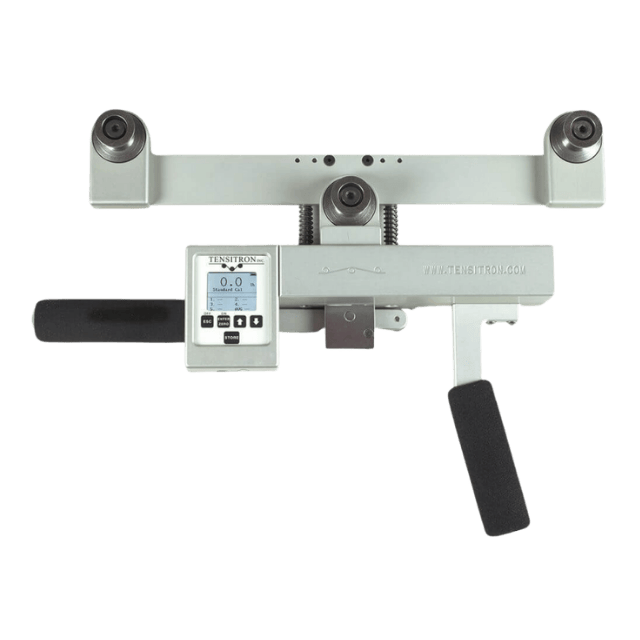
Instead, tension is verified directly on installed cable using a clamp-on tensiometer.
The cable passes across two fixed anvils while a third point applies controlled deflection. The required force is proportional to cable tension.
Measurement accuracy depends on calibration that matches the actual cable being measured.
Larger cables respond differently to deflection.
1×19 and 7×19 react differently under load.
Material stiffness changes measurement response.
Accuracy depends on matching the installed cable.
Installed cable tension cannot be recovered later on a test stand. To understand how the system is actually performing, tension must be measured directly on the cable in service.
Once tension is understood, the next question becomes practical: what actually happens when cable tension is too high, too low, or uneven across the system?
The consequences of incorrect tension vary by application, but the pattern remains consistent — too little and too much both create measurable problems.
Under-tension allows sway, wind movement, and potential antenna misalignment. Over-tension increases anchor loading and structural fatigue. Unequal tension can twist or bow the tower.
Uneven load sharing accelerates rope wear, reduces ride quality, and shortens service life. Rope sets require periodic re-equalization.
Incorrect tension increases uneven loading, overload risk, and operation outside intended safety limits.
Tension controls sag and geometry. Low tension increases deflection; excessive tension accelerates fatigue.
Proper cable tension is application-specific. The objective is not maximum tension — it is achieving the correct tension for the system.
Understanding the consequences is only half the process. The next step is learning how tension is actually measured on installed cable systems.
The measurement itself is quick, but a few details separate a trustworthy reading from a misleading one.
Confirm cable diameter, construction (1×19 or 7×19), and material before selecting calibration.
Use the correct calibration and roller/riser configuration. One cable construction will not accurately read another.
Position on a clean span away from fittings, sheaves, saddles, and clamps.
Allow readings to stabilize and average measurements to reduce variation.
For guy-wire groups, elevator rope sets, and multi-cable systems, measure every cable consistently so readings can be compared and equalized.
Note: Flat materials and unusual cable geometries may require specialized roller configurations and application-specific calibration.
Measurement technique matters — but cable construction, material, and calibration ultimately determine whether the reading is accurate.
A tensiometer does not measure tension directly— it infers tension from how the cable responds to controlled deflection.
Two cables carrying identical tension may produce different readings if diameter, lay, or stiffness differ.
Differences in diameter, construction, and material stiffness affect how much force is required to deflect the cable during measurement.
For example, a stiff 1×19 strand resists deflection more than a flexible 7×19 construction of the same nominal size. Likewise, galvanized and stainless cables can produce different measurement responses.
Larger cables resist deflection differently, changing the relationship between force and tension.
1×19 and 7×19 constructions behave differently even under identical loading.
Material stiffness changes how the cable responds during measurement.
Accuracy depends on matching calibration to the installed cable.
Match the calibration to the cable. When the cable changes, the calibration should change too.
Once measurement accuracy is controlled, the next requirement becomes understanding which standards define acceptable tension values.